Curriculum Links
Links to Primary Curriculum KS2 - relevant teaching resources are in brackets e.g. KS2 Voices Past and Present etc.
The learning resources link with a wide range of curriculum areas including but not limited to KS2 Geography, History, Citizenship, PSHE, English, Literacy, Drama, Art and Music.
All films, texts from Child Migrant Stories in Modern Britain: Oral Histories 1930s - Present Day (Bloomsbury 2024) and learning resources provide historical and contemporary life testimonies from child migrants including refugees fleeing war and conflict and from former parts of the British Empire.
They are meant to be a guide from which teachers can select and adapt according to the context. No specific timings are given for the activities.
The following selected examples of proposed links to the curriculum are based on KS2 National Curriculum in England but themes will be common and activities applicable to curricula in the rest of the UK and beyond.
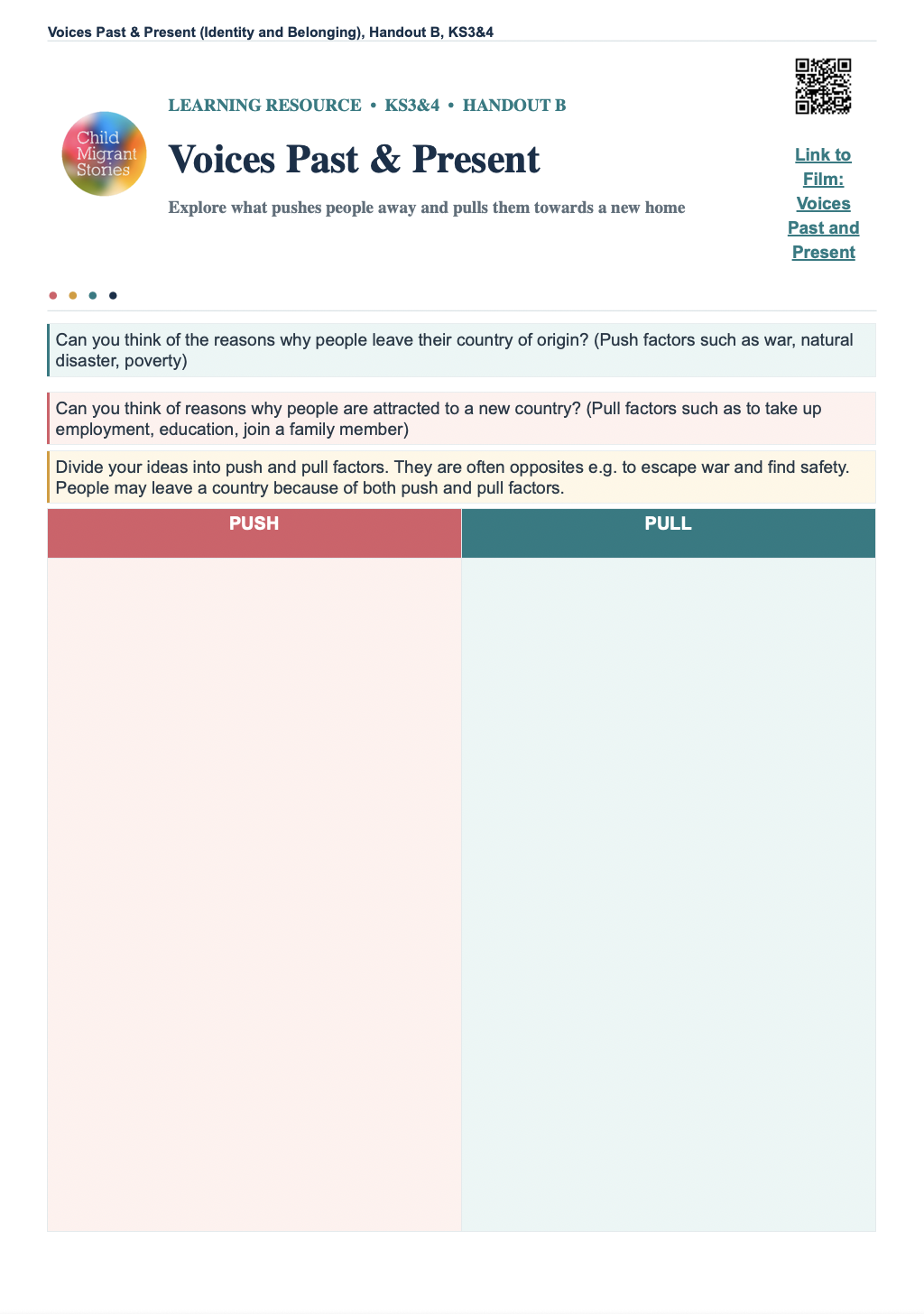
Geography KS2: Activities explore the push and pull factors that drive children to leave their homes (KS2 Voices Past and Present - Push/Pull) and their journeys by sea and air, requiring students to use world maps, atlases and globes 'thereby inspiring in pupils a curiosity and fascination about the world and its people...' (KS2 Voices Past and Present - Journeys).
History KS2: They introduce students to the historical context, including conflict and war that led children to move to the UK including from parts of the British Empire, showing 'how people’s lives have shaped this nation and how Britain has influenced and been influenced by the wider world’ (KS2 Life is a Destiny, KS2 Passing Tides, KS2 Ugwumpiti and KS2 Voices Past and Present - Push/Pull and Journeys).
There is great potential for local history studies and of East London in particular.
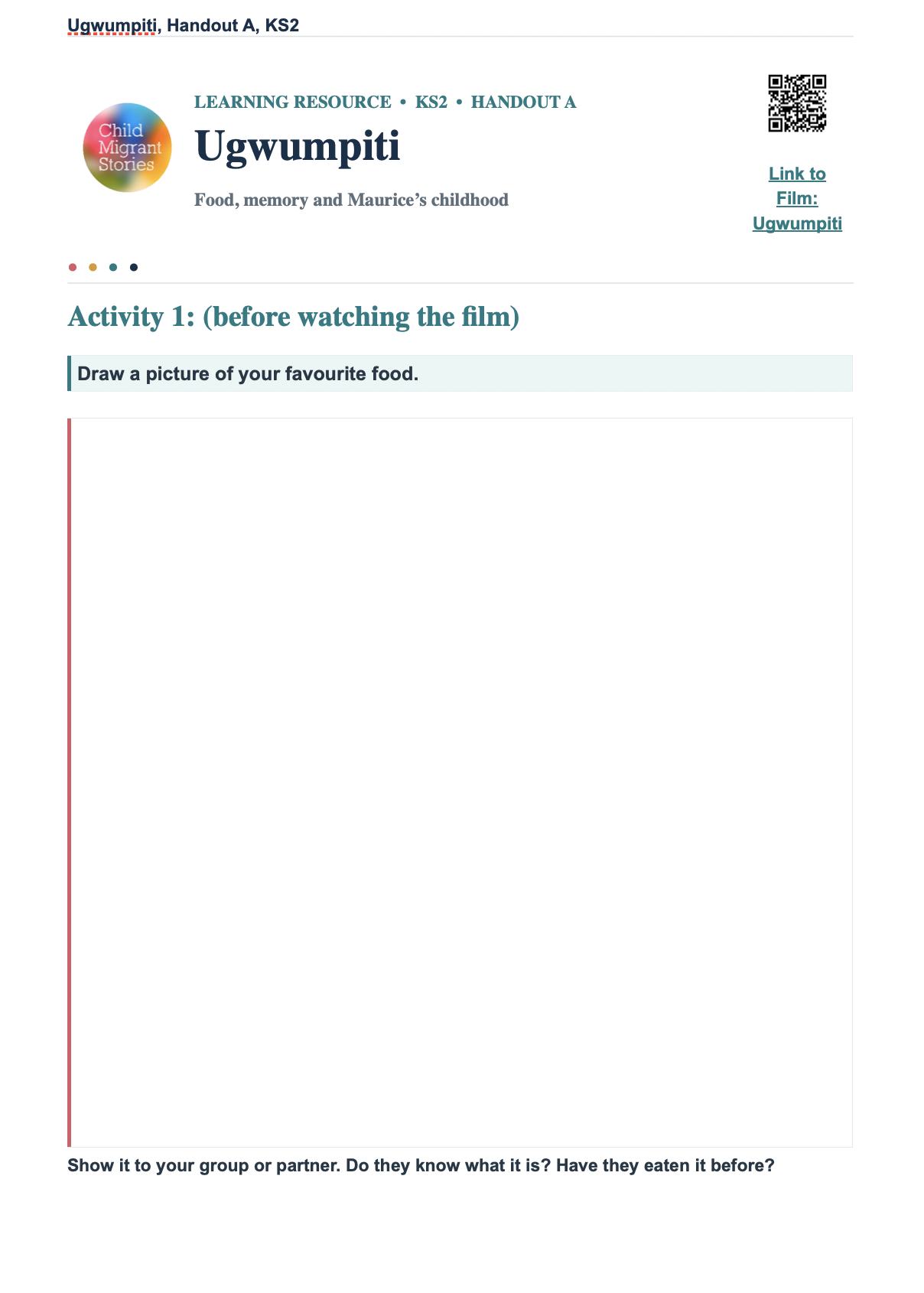
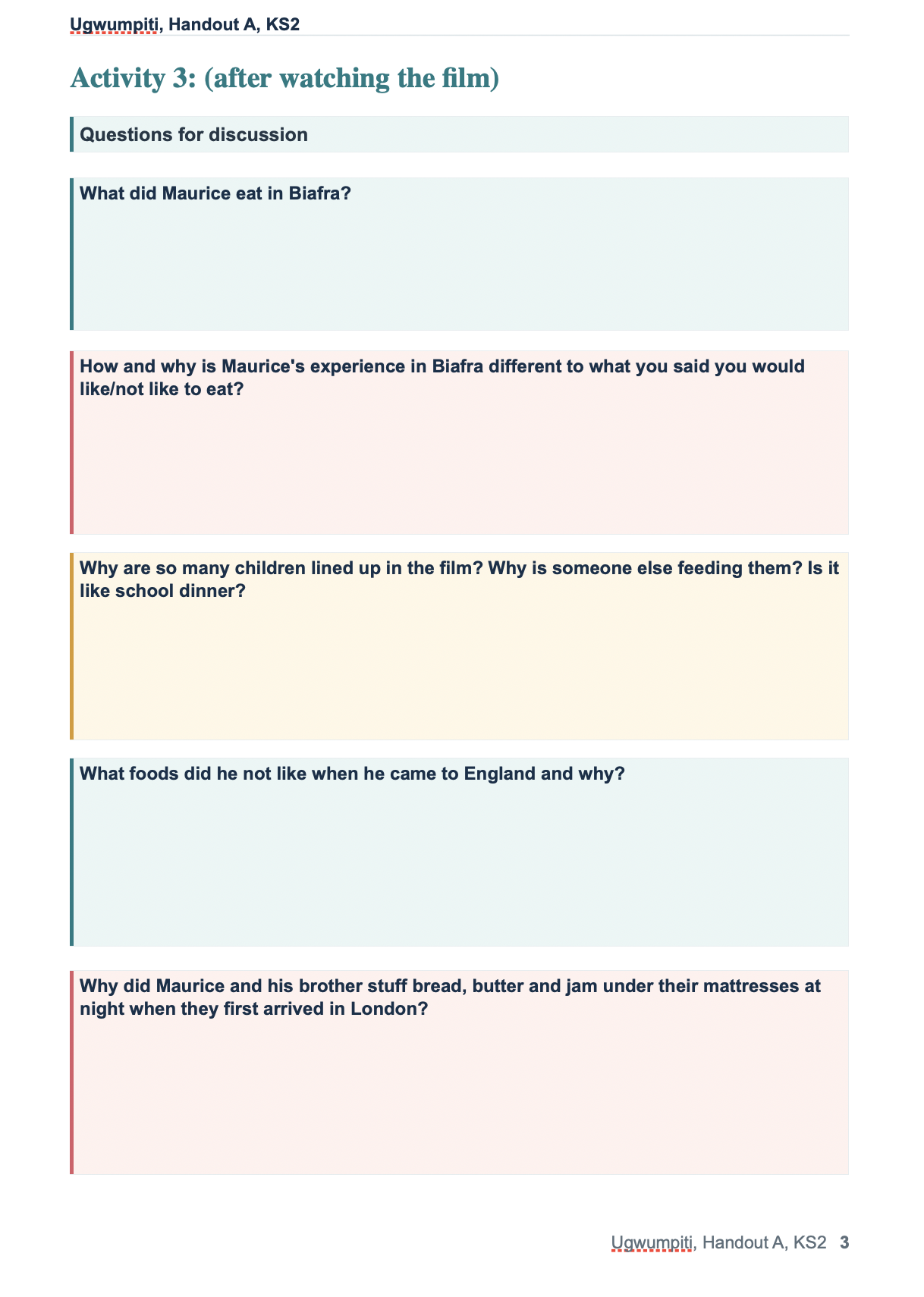
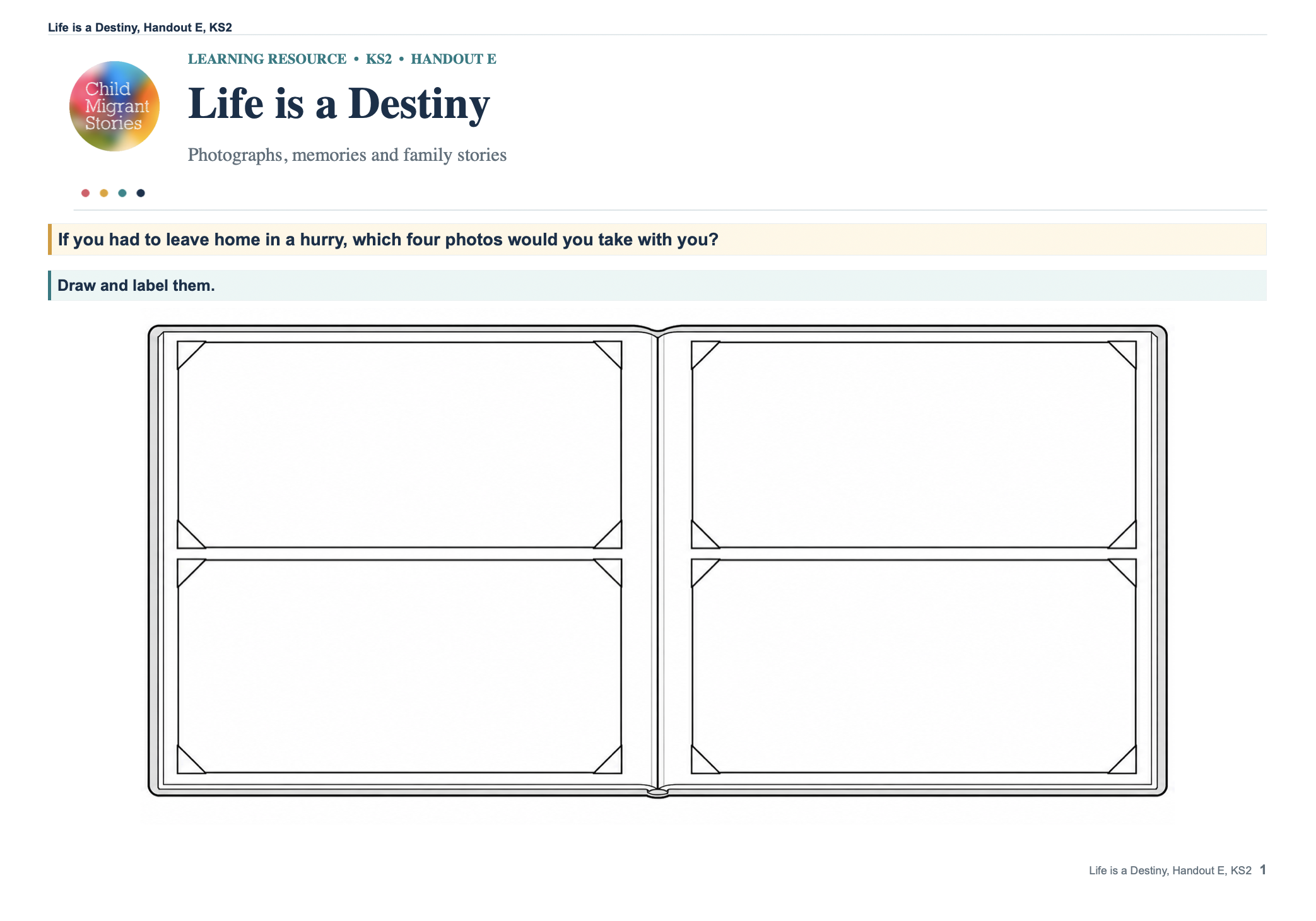
Citizenship and PSHE KS2: Activities are designed to 'develop empathy' through 'debating topical issues' and 'learning how to help others' (KS2 Citizenship Curriculum), introducing children to'Living in the Wider World', to issues of 'equality, human rights and diversity' (KS2 PHSE). Students are asked to make decisions about what to take if they had to leave home in a hurry (KS2 Life is a Destiny) ; how they would feel on a small boat on the China Sea and how to welcome a new migrant child into school (KS2 Passing Tides) ; to share food tastes from across the world and to understand why Maurice ate the food he did during war (KS2 Ugwumpiti).
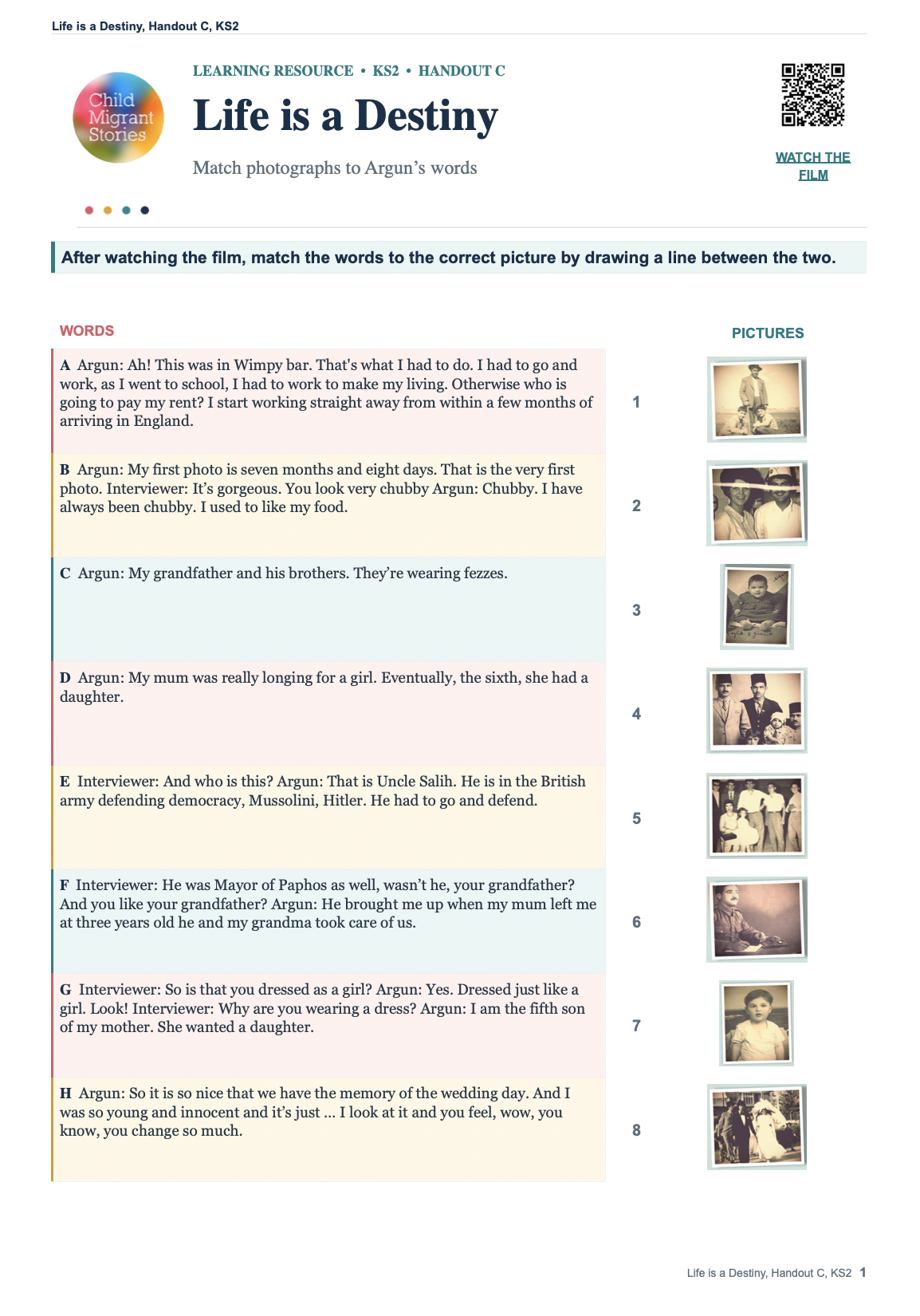
English and Literacy Curricula KS2: Activities introduce new and appropriate terminology (KS2 Passing Tides; KS2 Voices Past and Present - Push/Pull), ask students to match quotes and images from the film (KS2 Life is a Destiny), read passages and answer questions on children's journeys thus encouraging reading - comprehension and new vocabulary (KS2 Voices Past and Present - Journeys); write postcards home as a newly arrived child thereby enhancing writing and composition (KS2 Voices Past and Present - Push/Pull); engage in role play as both interviewer and interviewee based on child migrants' life testimonies and perform a poem based on child migrant stories developing skills in spoken language, participation, performance (KS2 Voices Past and Present - Push/Pull).
Music KS2: Students are asked to share nursery rhymes from across the world and describe their feelings listening to Maurice's music (KS2 Ugwumpiti); to create their own rap or song inspired by the music of Henry, a child soldier, from El Salvador (KS2 Voices Past and Present - Push/Pull).
Art and Design KS2: Students areasked to analyse Argun's old photos of Cyprus and draw stages of his life, objects and photographs they would take with them in a hurry (KS2 Life is a Destiny); to draw their favourite food (KS2 Ugwumpiti) to write about Linh's illustrations of her journey on the China Sea and to draw their own version of the boat (KS2 Passing Tides).
Links to Secondary Curriculum KS3-5 - relevant teaching resources are in brackets e.g. KS3 Passing Tides etc.
The learning resources link with a wide range of secondary curriculum areas including but not limited to KS3, KS4 and/or KS5 Geography, History, Citizenship, PSHE, English, Literacy, Drama, Art and Design, Music, Film and Media Studies. Some activities would suit a cross-curricular project e.g. across Citizenship and Art or Drama.
All films, texts from Child Migrant Stories in Modern Britain: Oral Histories 1930s - Present Day (Bloomsbury 2024) and learning resources provide historical and contemporary life testimonies from child migrants including refugees fleeing war and from former parts of the British Empire.
They are meant to be a guide from which teachers can select and adapt according to the context. No specific timings are given for the activities.
The following selected examples of proposed links to the curriculum are based on KS3, KS4 and/or KS5 National Curriculum in England but themes will be common and activities applicable to curricula in the rest of the UK and beyond.
Geography KS3 - 5: The films and related resources provide powerful case studies of different types of child migration e.g. economic migrant/asylum seeker; forced/voluntary; rural/urban; family/independent. They focuson the push and pull factors that drive children worldwide to leave their homes, thus increasing students' 'locational knowledge and spatial awareness of the location of different countries' (KS3 - 4 Voices Past And Present and KS4 Life is a Destiny);the challenges children face on the journey (KS3 - 4 Passing Tides - Refugees), settling into a new city, neighbourhood or school, speaking a different language, eating different foods, living with different family members, meeting new people and encountering hostility, thus enhancing 'place-based knowledge and the human process of migration' (KS3- 5 Ugwumpiti, KS3 -4 Passing Tides, KS3 - 4 Life is a Destiny and KS3 - 4 Voices Past and Present).
Activities are applicable to both an introductory unit on migration at KS3 level and specific units at:
i) KS4 - GCSE Cambridge IGCSE Migration/Settlements Unit; Edexcel B - UK evolving human landscapes unit and challenges of an urbanising world; AQA- changing economic world and urban issues and challenges; WJEC Urban issues in contrasting global cities and Development and Resource issues (particularly on role of British Cross in Nigeria-Biafra war in KS4 - 5 Ugwumpiti).
ii) KS5 - Cambridge AS/A level migration; Edexcel Globalisation/Superpowers; AQA Contemporary Urban Environments e.g. cultural diversity and social segregation.
History KS3 - 5: KS3 resources link to 'ideas, political power, industry and empire: Britain, 1745-1901' from former British colonies in Asia, Africa and the Caribbean (KS3 - 4 Voices Past and Present; KS3 Ugwumpiti), also from Cyprus e.g. identifying countries that were formerly part of the Ottoman and British Empires and the impact on Argun Imamzade's uncle who fought for Britain during WW11 (KS3 Life is a Destiny). Resources also relate to 'challenges for Britain, Europe and the wider world 1901 to the present day' e.g. focussing on why Linh Vu fled Vietnam (KS3 - 4Passing Tides - Refugees) and what the country was like for South Vietnamese after the war.
At KS4 resources link to GCSE History - OCR Migration to Britain c1000 to c2010; AQA Britain: Migration, empires and the people: c790 to the present day; Edexcel Migrants in Britain, c800–present: Notting Hill, c1948–c197). All three GCSE boards incorporate experiences of child migrants from former colonies and who are refugees e.g. 'from Vietnam, Syria, Somalia' (Edexcel). Several activities, (KS4 Passing Tides - Newspapers and KS4 -5 Ugwumpiti) encourage 'debate over immigration - political racism and antiracism; attitudes towards, and treatment of, political refugees and asylum seekers' (OCR) 'political campaigns among migrant communities... race riots... ongoing experiences of the Windrush generation... the role of the media' (Edexcel).
Activities also link to KS5 AQA A Level Impact of Decolonisation in Africa, Asia and the Caribbean; OCR A Level - From Colonialism to Independence 1857 - 1965 (KS4 - 5 Ugwumpiti).
There is great potential for local history studies and of East London in particular.
Citizenship and PSHE KS3 - 4: There is significant potential for these resources to be used for both KS3 - 4 Citizenship and PHSE, particularly given schools can develop their own curriculum for KS3 PHSE. Discussions on how to welcome a child migrant (KS3 Ugwumpiti) and the role of centres for diaspora communities (KS3 Passing Tides - Community) link to KS3 PHSE focus on 'roles played by public institutions and voluntary groups in society and ways in which citizens work together to improve their communities'.
Identifying articles that apply to child migrants in the UN Convention on the Rights of the Child (KS4 Life is a Destiny) relate to KS3 - 4 Beyond UK Citizenship and its focus on 'human rights and international law'. Children's stories of being bullied because of their foreign accent or colour (KS3 - 4 Voices Past and Present) and the activity ofcreating a more inclusive welcoming school (KS4 - 5 Ugwumpiti) relate to KS3 - 4 PHSE curriculum on 'diversity, human rights, democracy, and bullying'. Students research in evaluating claims and counterclaims about migration in the press and elsewhere (KS3 - 4 Passing Tides- RefugeesKS4, Passing Tides - Newspapers, KS4 - 5 Ugwumpiti) link to students' ability outlined in KS3 - KS4 Citizenship curriculum to 'research and interrogate evidence, debate and evaluate viewpoints' and to 'explore political and social issues critically'.
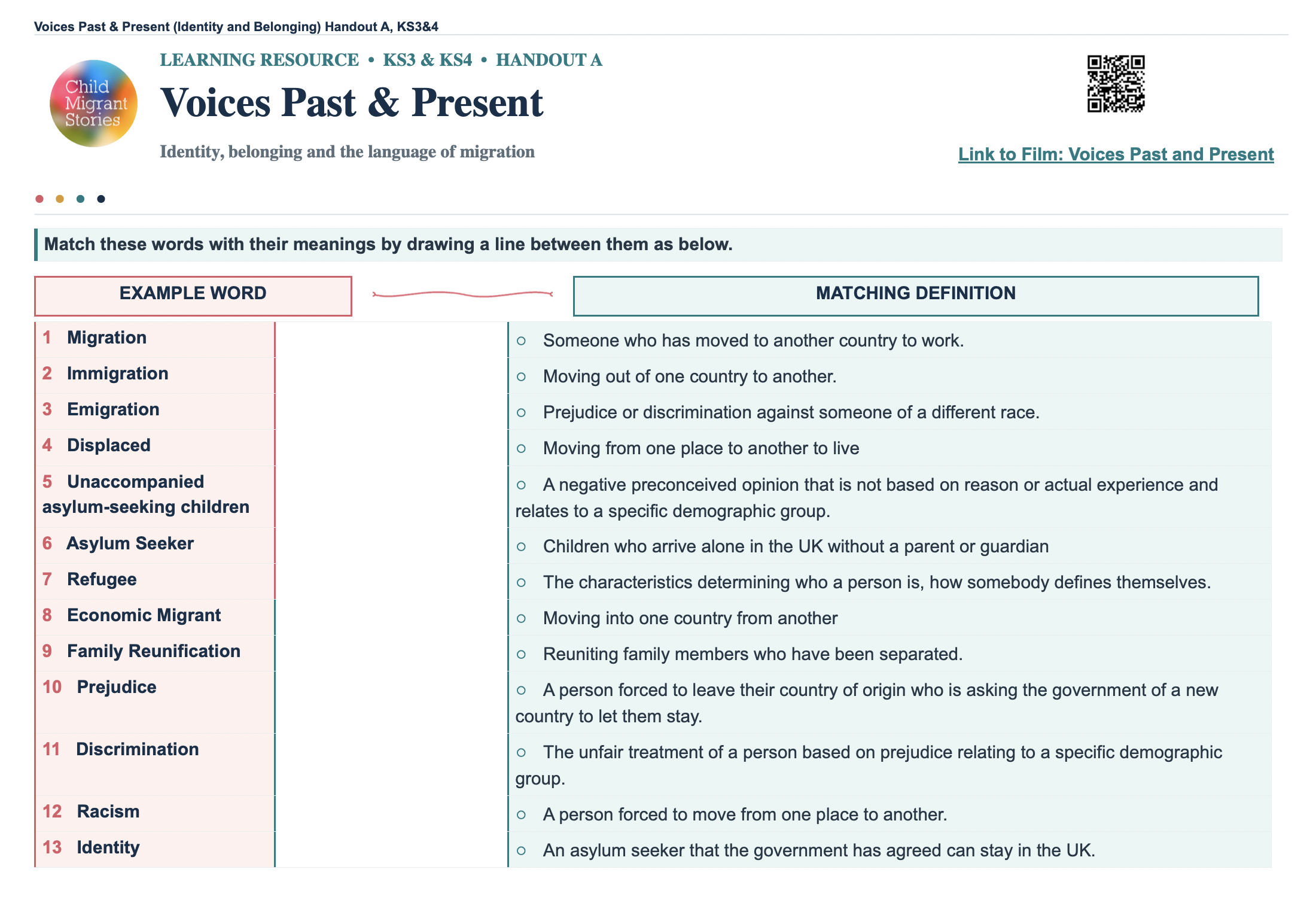
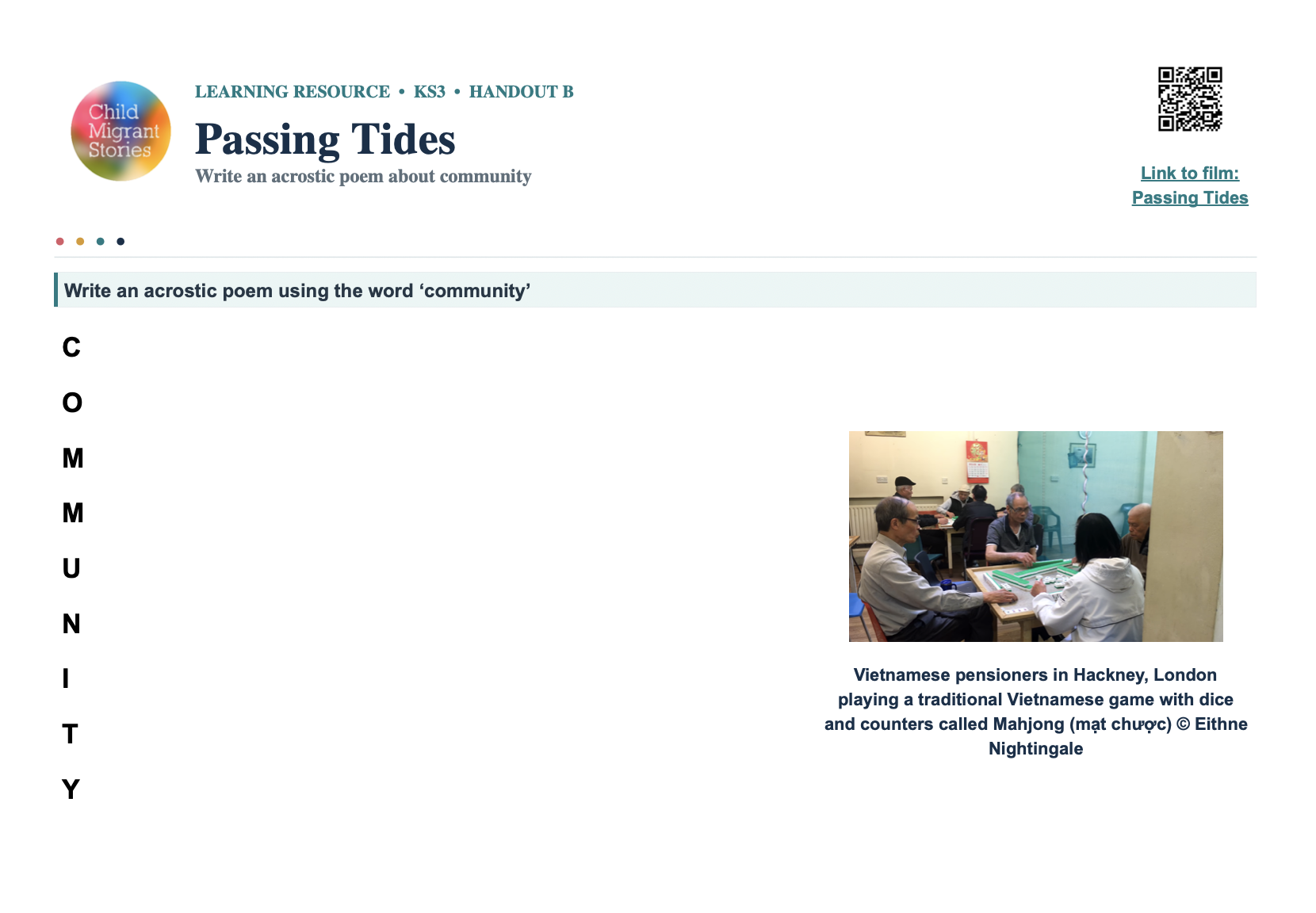
English and Literacy Curricula KS3 - 4: Students are introduced to 'sophisticated vocabulary' related to conflicts in countries of origin, to migration and settlement; and are asked to match words with definitions (KS3 - 4 Voices Past and Present, KS3 - 4 Passing Tides - Refugees, KS4 Life is a Destiny, KS3 and KS4 - 5 Ugwumpiti) and to reflect on the use of language to describe migrants and their experiences (KS4 - 5 Ugwumpiti).They are encouraged to engage with the poem Home by Warsan Shire 'No one leaves home unless home is the mouth of a shark' (Passing Tides - KS3 - 4 - Refugees); to develop 'creative writing' by composing a 100-word diary entry of a child who has crossed the British Channel (KS3 - 4 Passing Tides - Refugees) and an acrostic poem using the word COMMUNITY (KS3 Passing Tides - Community).
Through role play, students act as interviewer and interviewee after reading child migrant testimonies and devising appropriate questions (KS3 - 4 Voices Past and Present), to'engage in formal debate, drama, and public speaking... to develop articulate, confident communication'. Students can be encouraged, but with appropriate safeguards, to bring in their own or their families' experience of migration (see Addressing Sensitive and Controversial Issues in Teaching) and to develop 'digital resistance' by reviewing misinformation online and social media e.g. over the story of Mo Farrar who was trafficked as a child from Somalia (KS4 - 5 Ugwumpiti and Voices Past and Present 3 - 4).
Art and Design KS3/4: Students are asked to sketch out, digitally design and/or model a community centre, inspired by An Viet (KS3 Passing Tides - Community); to respond to the poem Home by Warsan Shire (KS3 - 4 Passing Tides - Refugees) through 'diverse techniques (drawing, painting, sculpture, digital media)'. The films and resources provide a rich resource of visual material to develop 'creativity, technical proficiency, and critical understanding '. These include family photographs of Argun Imamzade including black and white studio portraits from Cyprus in the 1950s (KS3 Life is a Destiny), drawings by Linh Vu of her memories of her journey from Vietnam by boat and British ship on the China Sea in the 1970s (Passing Tides film); archival and press photographs in both the films and resources including of conflicts worldwide and of child migrants.
Film and Media Studies - both cross curricula and for KS4 - 5 Film/Media Studies:
The resources encourage responses to press articles thereby developing 'critical thinking, analytical skills, and media literacy' that can be used within a range of curriculum areas at KS3 - 5 as well as for KS4 - 5 Media/Film Studies (AQA, Eduqas, OCR and WJEC; BTEC Tech Award in Creative Media Production). These include (KS4 Passing Tides - Newspapers);
a Guardian article of Vietnamese refugees settling in a Welsh town in 1978 alongside a Daily Mail article in 1975 on how the newspaper helped organise an airlift of “the tragic children of Vietnam”.
images from the Independent of a three-year-old Syrian boy drowned in the Aegean Sea in 2015.
two online articles (Daily Record and Daily Mail) on the arrival of Syrian families on the Isle of Bute in Scotland in 2025.
on the visa scheme for Ukrainians fleeing Putin's invasion in 2022 (Telegraph and Express) compared with the experience of Afghans as illustrated by text.
on the painting over of a Disney mural in a centre for child migrants in 2023 (I Weekend).
The films, co-produced with child migrants, a process described in Child Migrant Stories in Modern Britain: Oral Histories 1930s - Present Day p.10 could also be used as a teaching resource.
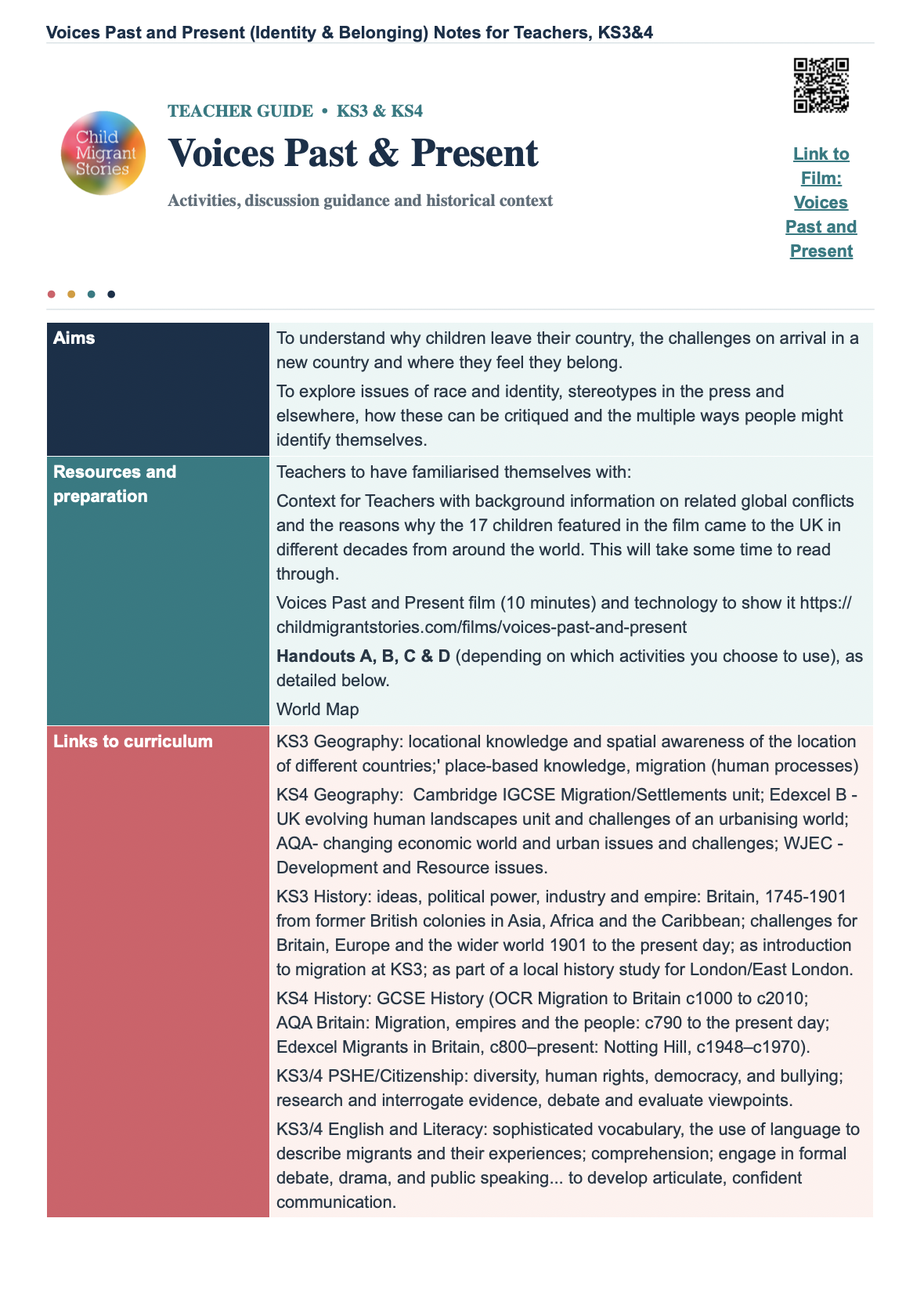
Explore the gallery below to see a preview of some of the resources and teacher notes: